Saturday, April 25, 2009

America

On Friday October 12 Columbus arrived at the small island of the Lucayos.They saw naked people. The Admiral went on shore in the armed boat.Having landed, they saw trees very green, and alot of water, and fruits of many kinds. Shortly after landing, many of the island's inhabitants assembled on the beach and Columbus gave them gifts of red hats and beads. The natives came with gifts of parrots, cotton and other goods. In describing the natives, Columbus wrote: "They go as naked as when their mothers bore them, and so do the women, although I did not see more than one girl. They are very well made, with very handsome bodies, and very good countenances."
Portugal

Christopher Columbus arrived in Portugal as the result of a naval battle which blew his ship out from under him and forced him to swim for his life. He came ashore near Lagos, on the southern coast of Portugal. In late 1483 or early 1484 he went to John II, the Portuguese king, for ships and men to go on the Atlantic voyage, offering to find Cipangu and India. The king called in experts, including astronomers and mathematicians, to judge the offer. They turned Columbus down, believing that the Atlantic distances involved were far greater than Columbus had estimated. With his wife's death in the early 1480's and the rejection of his offer, he left his career in Portugal.
Spain
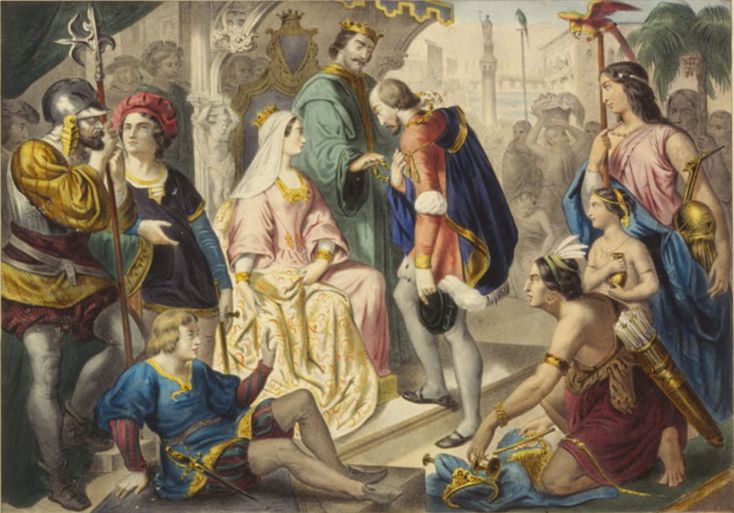
Christopher Columbus got support from the king and queen of Spain, Ferdinand and Isabella, they believed he could find some precious jewelery and gold and agreed to give him 3 ships for his journeys. In 1492 Columbus set sail from Palos, Spain with three ships: the Nina, the Pinta and the Santa Maria. The voyages were financed by Ferdinand and Isabella (king and queen of Spain) by making the city of Palos pay back a debt to the crown by providing two of the ships. He returned to Spain for the last time on November 7, 1504. He died at Valladolid, Spain on May 20, 1506, at the age of 55.
Genoa

Christopher Columbus was boring in Genoa. His birthday is between August and October of 1451. Today Genoa is part of Italy, but in 1451 it was an independent city-state, and the richest city in the western Mediterranean. The native language of Genoa at that time was Ligurian. Columbus spoke several languages at the time he was an adult, Latin, Portuguese, Spanish, and maybe Catalan. This is why its difficult to know his nationality. Christopher Columbus appears to have donated one-tenth of his cash gained from his discovery of the Americas to the Bank of San Giorgio in Genoa for food.
The Canary Islands

In August 3, 1492, Columbus left from Palos, Spain and sailed to the Canary Island, where he made repairs. His trips to Africa brought him close to the Canary Islands and knowledge of the Canary Current. He also saw a mountain, Mount Teide on Tenerife erupt in 1492 on his way past the, unconquered islands at his time. His plan was to sail to the Canary Islands then make a long leap accross the Ocean Sea to find the gold treasures of the Indies. Columbus calculated that the Canary Island Layed only about 4440 Km from Japan, the actual distance is about 19,000 Km.
Wednesday, April 15, 2009
Trinidad

In July of the year 1498, Columbus had the unluckiness on this trip of entering a dead space in the ocean where wind and ocean currents die and the heat is deadly. After a little more than a week the crew was saved by a south-easterly that pushed them westward. Changing course to the north prevented Columbus from discovering South America but it did bring him to an island with 3 mountain peaks. Columbus named it Trinidad. When Christopher arrived on these shores the Arawaks were so jealous by the sight of his huge ships which made their little hand carved canoes look like a joke, they treated him and his crew with great deference.
Puerto Rico

On his way to Hispaniola, Columbus discovered the beautiful Island of Puerto Rico. Voyagers were eager to get off the ships, wanting to go look and find good, or at the least, start colonizing. He found the island populated by as many as 60,000 Arawak or Taino indians, which were friendly compared to the Carib indians in some of the more southerly islands which were warlike and to some degree cannibalistic. The conquest of the island didn't take long, and the peaceful Tainos were put to the task as slaves to mine the gold that was found on the island.
The Bahamas

Land was sighted at 2 a.m. on October 12, 1492, by a sailor named Rodrigo de Triana aboard the ship. Columbus called the island San Salvador; the natives called it Guanahani. During his voyage to the Bahamas he encountered weird people, though he said that they were peaceful and nice. In his journal he wrote “Many of the men I have seen have scars on their bodies, and when I made signs to them to find out how this happened, they indicated that people from other nearby islands come to San Salvador to capture them; they defend themselves the best they can.” The Bahamas was one of his first voyages in his life.
Subscribe to:
Posts (Atom)